

Fractional CAIO
Fractional Chief AI Officer (CAIO): Role, Cost and First 90 Days
A part-time Chief AI Officer who sets your AI strategy and policy, then gets the use cases built.
Get a free proposal
Tell us what you need. A consultant replies within one working day.
01
What is a fractional Chief AI Officer?
A fractional Chief AI Officer (CAIO) is a senior AI executive who leads a company's AI strategy, governance and adoption part time, usually a few days a month on a retainer. They decide which AI use cases to pursue, set the rules for using AI safely and own the results.
Fractional is about the hours, not the authority. A fractional CAIO sits in leadership meetings, signs off AI tools and vendors, and reports to the CEO or board on what AI delivers. It suits companies that know AI matters but are not yet large enough, or certain enough, to hire a full-time executive.
The role goes by several names. Fractional head of AI, fractional AI officer, part-time Chief AI Officer and virtual Chief AI Officer describe the same arrangement. Chief AI Officer as a service usually means the person is supplied by a firm, often with a team that can build. An interim Chief AI Officer is different: typically full time for a fixed term while a permanent hire is found. A fractional AI consultant is often a project adviser who does not own outcomes.
If your main question is technology leadership in general rather than AI, read our fractional CTO page instead.
02
What does a Chief AI Officer do? The role and job description
A Chief AI Officer is the executive accountable for how an organisation uses artificial intelligence: where it is applied, how it is governed, what it costs and whether it pays back. In an IBM Institute for Business Value survey of more than 600 CAIOs in early 2025, 26% of organisations had a CAIO, up from 11% in 2023. IBM's May 2026 study of 2,000 CEOs and senior leaders put the figure at 76%. The samples differ, so treat both as a direction of travel among large organisations. In April 2025, OMB memorandum M-25-21 told every US federal agency to retain or designate one within 60 days.
A typical Chief AI Officer job description, full time or fractional, covers:
- AI strategy: link AI to the goals the business already has, and decide where AI should and should not be used.
- Use case portfolio: score ideas, fund a few and stop what is not working.
- Governance and risk: write the AI policy, classify use cases by risk, and run the review process for new tools, models and vendors.
- Data readiness: make sure the data each use case needs exists, is accurate and may be used.
- Delivery: lead the people who build AI, internal or external, against measurable results.
- Adoption and skills: train staff, appoint champions and change workflows so tools are actually used.
- Budget and vendors: track AI spend and negotiate with providers.
- Reporting: tell the leadership team and board what AI is delivering, what it costs and what risks are open.
How the Chief AI Officer role differs from neighbouring roles
| Role | Main focus | Where it overlaps with the CAIO |
|---|---|---|
| Chief AI Officer (CAIO) | Where AI creates value, how it is governed, and whether it is adopted | Not applicable |
| Chief Technology Officer (CTO) | The product's technology, engineering team, architecture and security | AI features in the product |
| Chief Information Officer (CIO) | Internal IT, business systems, ERP, networks and support | Rolling out AI tools to staff |
| Chief Data Officer (CDO) | Data quality, ownership, governance and analytics | Data readiness and protection |
| Head of data science or ML | Building and maintaining models and pipelines | Delivery; often reports to the CAIO |
In a company of 50 to 1,000 staff, the CTO or CIO often carries AI on top of a full job, and the responsibilities above end up owned by nobody. That gap is what a fractional CAIO fills.
03
Signs you need a fractional Chief AI Officer
04
When you do not need a fractional CAIO
Skip it, or start smaller, if one of these applies:
- You have one well-defined AI project. If the question is "can AI read our invoices", a scoped project with an AI consulting partner or an automation team is cheaper than ongoing leadership.
- Your data is not ready for anything yet. If core records live in spreadsheets and email, the first job is a data strategy, not an AI programme.
- AI is your product and you have a large ML team. At that point the role needs a full-time executive. A fractional CAIO can help define and hire for it.
- Nobody senior will sponsor it. Without a sponsor and decision rights, the role becomes advisory. Fix that first.
The test: if a bad AI decision (a data leak, a failed rollout, unused licences) would cost more than a few months of retainer, the role is worth it.
05
What a fractional CAIO does, by company type
Small and growing businesses taking AI seriously for the first time
In a business of 20 to 200 people the job is turning scattered enthusiasm into a short, funded plan. The first step is a plain-language AI use policy, then two or three use cases that remove hours of manual work, such as customer questions, quotes, documents and reports.
- AI use policy and approved tool list
- Staff training and an AI champion in each team
- Monthly AI spend and hours-saved report
Mid-market companies with pilots that have not scaled
Companies with a few hundred to a few thousand staff usually have plenty of AI activity and little coordination. The fractional CAIO builds one portfolio, scores every initiative on value and feasibility, closes duplicates and pushes the best two or three into production. They set up the governance structure (a small AI council, a risk-tiered review, a register of AI systems).
- AI system register and portfolio review
- Risk-tiered approval process
- Quarterly AI report to the leadership team
Pharma, healthcare and financial services
In regulated industries the governance half of the role is larger. Health and financial data carry legal duties, and uses such as credit decisions fall into higher-risk categories under laws like the EU AI Act. The fractional CAIO maps each use case to the rules that apply, sets validation and human review standards, and works with compliance, legal and medical teams. In pharma, early use cases often sit in commercial operations and document-heavy processes.
- Use case risk classification against applicable regulations
- Validation, monitoring and human review standards
- Close work with commercial analytics and patient data teams
Private equity firms and their portfolio companies
For a private equity owner, AI is a value creation lever that has to show up in EBITDA within the hold period. A fractional CAIO can assess several portfolio companies at once, find use cases that repeat across them (finance close, customer service, procurement) and reuse what works. They also review AI claims in acquisition targets during due diligence.
- Portfolio-wide AI readiness scoring
- Repeatable use cases across companies
- AI due diligence on acquisition targets
- One AI report for the board
06
Phase one: the AI readiness assessment
A good fractional CAIO engagement starts with an AI readiness assessment. It looks at five areas:
- Data: where the data each likely use case needs lives, how complete and accurate it is, who owns it, and whether it can lawfully be used for AI.
- Processes: which workflows are repetitive, rules-based or document-heavy enough for AI or automation to take load, and how much time they consume today.
- People: skills, appetite and capacity in each team, who would own each use case.
- Tools and technology: the AI tools already in use and the systems they would connect to.
- Risk: data protection, regulatory exposure, intellectual property, vendor terms and the reputational cost of an AI mistake in your market.
The output is short and decision-ready: a readiness score for each area, a ranked shortlist of use cases with a rough business case for each, the data gaps that block them, a first draft of the AI policy, and a 90-day plan. For a smaller business it often takes two to three weeks.
At Greenwolf this is our AI readiness audit: we review your processes, data and tools and come back with the opportunities ranked by value and effort. Many companies start there and decide afterwards on ongoing leadership.
07
How a fractional CAIO prioritises AI use cases
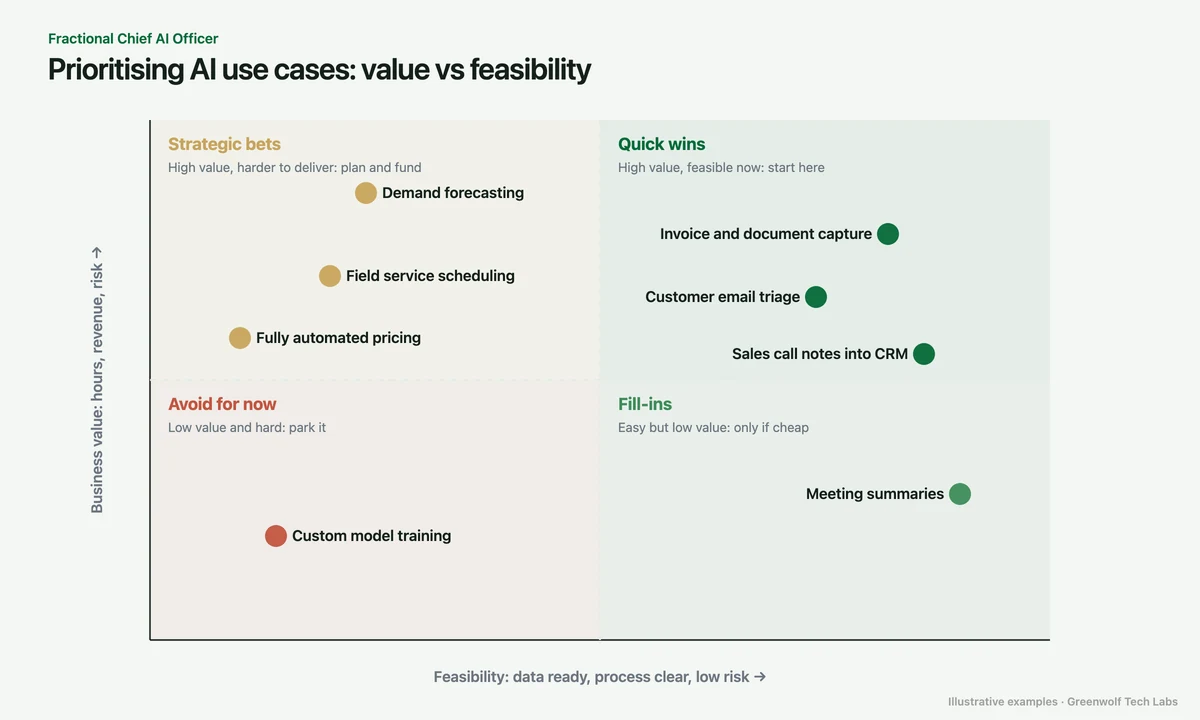
The shortage is rarely AI ideas; it is a fair way to choose between them. A fractional CAIO scores every candidate use case on two axes and plots them on a simple matrix.
Value asks what the use case is worth if it works: hours saved, revenue gained, errors or risk reduced and how directly it supports an existing goal. Feasibility asks how likely it is to work in your company: whether the data exists and is clean enough, whether the process is stable, how hard the integration is, what the risk tier is, and whether a team will own it.
- Quick wins (high value, high feasibility): do these first. Typically document processing, knowledge search, reporting and service triage.
- Strategic bets (high value, lower feasibility): plan these deliberately. They often need data work first, or a pilot with stop criteria: forecasting, pricing, agents acting across systems.
- Fill-ins (lower value, high feasibility): let teams do these with approved tools and the AI policy, without central funding.
- Avoid (lower value, lower feasibility): say no clearly, and record why, so the idea does not come back every quarter.
Every use case needs a named owner and a baseline before any build starts, and scores are reviewed each quarter as data and models improve.
08
AI governance: policy, risk tiers and the frameworks behind them
Governance is the half of the role that is easiest to skip and most expensive to get wrong. It does not need to be heavy. It needs four things:
- An AI use policy: which tools staff may use, with which kinds of data, when output must be checked by a person, and when AI use must be disclosed.
- Risk tiers: a simple classification: low (internal drafting), medium (customer-facing content) and high (decisions about people, health, credit or safety), with more review and human oversight as the tier rises.
- Vendor and model review: a short checklist before any AI tool or model is approved: data retention and training on your data, where data is processed, security, contract terms and exit.
- Data protection: lawful basis for using personal data, minimisation, access control, and a record of which AI systems touch which data.
Three external references sit behind these, summarised as of October 2026.
EU AI Act. The regulation entered into force on 1 August 2024. Bans on prohibited AI practices and the AI literacy duty applied from 2 February 2025, and obligations for general-purpose AI model providers from 2 August 2025. Transparency duties under Article 50 (for example chatbot disclosure and deepfake labelling) apply from 2 August 2026. The Digital Omnibus amendment, adopted in June 2026 and in force since 27 July 2026, moved the deadline for stand-alone high-risk systems in Annex III (such as employment and credit scoring) from 2 August 2026 to 2 December 2027, and for high-risk AI built into regulated products (Annex I) to 2 August 2028. It also softened the AI literacy duty. It reaches companies outside the EU whose AI systems or outputs are used there.
NIST AI Risk Management Framework. Published by the US National Institute of Standards and Technology in January 2023, the AI RMF 1.0 is voluntary and organises AI risk work into four functions: Govern, Map, Measure and Manage. NIST added a Generative AI Profile (NIST AI 600-1) in July 2024, which lists twelve risks specific to or amplified by generative AI.
ISO/IEC 42001. Published in December 2023, it is the international standard for an AI management system, structured like ISO/IEC 27001, and organisations can be certified against it.
In pharma and healthcare these sit on top of sector rules on patient data, so AI governance works best alongside the commercial analytics team that owns the data.
You rarely need all three. Use the NIST functions to structure the work, check EU AI Act exposure if you sell into the EU, and consider ISO/IEC 42001 when enterprise customers ask for it. This is general information, not legal advice; for regulated decisions, involve your legal counsel.
09
Fractional CAIO vs full-time CAIO, fractional CTO, AI strategy consultant, AI agency and AI committee
Companies usually weigh a fractional Chief AI Officer against five alternatives.
| Option | Time and term | Owns AI outcomes? | Independent of vendors? | Best for |
|---|---|---|---|---|
| Fractional CAIO | A few days a month, ongoing, reviewed quarterly | Yes, over time | Should be; ask about referral fees | SMBs, mid-market and PE portfolios that need AI leadership but not a full-time executive |
| Full-time CAIO | Full time, permanent | Yes | Yes | Large enterprises with a big AI budget and an in-house AI team |
| Fractional CTO | One to three days a week, ongoing | For technology overall; AI is one item | Yes | Companies whose main need is product, engineering and infrastructure leadership |
| AI strategy consultant | A fixed project, often 4 to 12 weeks | No, delivers a recommendation | Usually | A one-off strategy, readiness review or board paper |
| AI agency or implementation partner | Per project or per build | For what it builds | No, it sells its own work | A clearly specified use case with an owner on your side |
| Internal AI committee | Part of existing managers' time | Shared, which often means nobody | Yes | Policy and coordination once someone senior drives it |
The combinations are common. Many companies keep an internal AI committee and add a fractional CAIO to chair it. We would caution against letting an AI agency set your strategy: it cannot judge its own proposals.
10
How much does a fractional Chief AI Officer cost?
There is no official rate card. Below are published figures, each named and dated. Most come from firms that place or sell fractional executives, so treat them as market signals, not quotes.
Published fractional CAIO fees (2026)
| Source and date | Who they are | Fractional CAIO fee |
|---|---|---|
| JRG Partners, 29 September 2026 | Executive search firm | $5,000 to $30,000 a month; $8,000 to $30,000 for an embedded, intensive engagement; $96,000 to $360,000 in year one |
| ThirstySprout, 29 July 2026 | Talent and hiring firm | $5,000 to $30,000 a month (citing Exec Roster); described as 20% to 35% of the loaded cost of a full-time executive |
| Stealth Agents, 28 July 2026 | Staffing firm | $5,000 to $30,000 a month, or $60,000 to $360,000 a year for standard engagements |
Published Chief AI Officer salary figures (US, 2026)
| Source and date | Figure | Notes |
|---|---|---|
| Orbyt, last updated September 2026 | $310,000 estimated average base; range $230,000 to $400,000. By company size: $279,000 (under 50 staff) to $372,000 (5,000+ staff) | Computed estimates, not measured salaries, per the source |
| Stealth Agents, 28 July 2026, citing Glassdoor | $353,220 average base; $494,507 at the 75th percentile | Base salary only |
| JRG Partners, 29 September 2026 | Median base around $353,000; $511,000 to over $700,000 fully loaded in year one | Year one includes bonus, equity, benefits and search fees of $100,000 to $150,000 |
| EPC Group, updated 9 October 2026 | Base $280,000 to $400,000; year-one total $500,000 to $870,000 or more | Adds bonus and equity, benefits and payroll tax, and a one-time recruiting fee; EPC sells a virtual CAIO service |
Where the sources agree and disagree:
- The fractional range is suspiciously uniform. Three sources give the same $5,000 to $30,000 a month, which suggests they draw on each other rather than independent data.
- Annual figures do not always reconcile. ThirstySprout's annual range ($60,000 to $180,000) is lower than twelve months of its own monthly range; the source does not explain the gap, and shorter engagements are the likely reason.
- Salary estimates differ by about $40,000 at the midpoint. Orbyt's computed $310,000 sits below the $353,000 figure that Stealth Agents and JRG Partners attribute to Glassdoor. JRG Partners and EPC Group agree that year-one cost of a full-time CAIO exceeds $500,000.
- Almost every source is a vendor. JRG Partners, ThirstySprout and Stealth Agents place executives; EPC Group sells a virtual CAIO service; Orbyt is a jobs platform. Greenwolf sells this service too.
Two costs sit outside the retainer: building the use cases, and the tools themselves (model usage, licences and hosting).
11
What a fractional Chief AI Officer does in the first 90 days
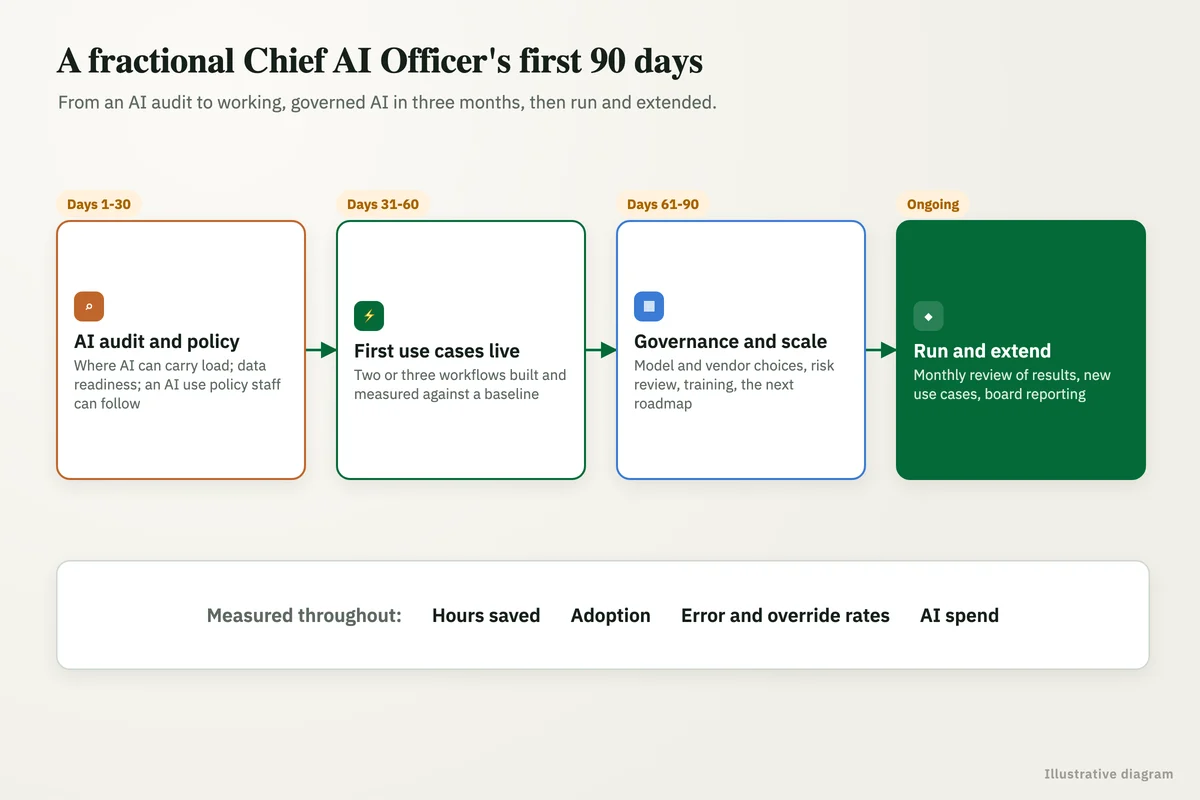
Days 1 to 30: readiness and guardrails
Interviews, an inventory of AI tools already in use, and the AI readiness assessment. An interim AI use policy goes out early, because staff are using AI already. Every KPI gets a baseline.
Days 31 to 60: portfolio and first builds
Use cases scored on value and feasibility, a portfolio agreed with leadership, and two or three quick wins scoped with owners and stop criteria.
Days 61 to 90: launch, govern, plan
The first use cases go live and are measured. Risk tiers, the approval route and the AI register are set, teams are trained, and a roadmap for the next quarters is agreed.
After day 90: run and extend
A monthly portfolio review, a quarterly board report, new use cases as the first ones prove out, and an honest view of whether you need more time, less, or a full-time hire.
12
KPIs: how to tell whether AI leadership is working
Agree the measures in the first month and baseline them before anything is built. These are the KPIs we use most:
| KPI | How it is measured |
|---|---|
| Adoption | Weekly active users of each AI tool or workflow as a share of intended users |
| Hours saved | Time per task before and after, multiplied by volume |
| Cost | AI spend (licences, model usage, hosting, build) against the value delivered |
| Quality | Error, override or escalation rate on AI output |
| Risk incidents | Data exposures, policy breaches and harmful outputs logged and resolved |
| Use cases shipped | Use cases in production, and time from approval to launch |
In the first quarter expect baselines, a policy and one or two use cases live. If nothing measurable has changed after two quarters, that is a conversation to have.
13
How Greenwolf's fractional CAIO works
A senior lead
One named senior lead who owns the AI roadmap and governance and is accountable for results.
- Readiness assessment
- AI policy and risk tiers
- Portfolio and board reporting
AI agents
Agents and assistants that answer, triage and act across your systems, with a person in the loop.
- Customer and internal assistants
- Agents that act across systems
Workflow automation
The repetitive, document-heavy work removed with automation and AI, which is where most quick wins sit.
- Document processing
- Reporting and hand-offs
Data foundations
The pipelines, warehouses and data quality fixes that the strategic bets depend on.
- Pipelines and warehouses
- Data quality fixes
Governance in practice
Vendor and model reviews, the AI register and the audit trail, kept current.
- Vendor checklists
- AI system register
Measurement
Every use case baselined before build and reported monthly on adoption, hours saved, cost and incidents.
- Monthly KPI report
14
Engagement options
The difference between our model and a solo fractional CAIO is that the person setting the strategy has a team that can build it: AI agents, AI workflow automation and the data foundations underneath them. Strategy that stops at a slide deck is a common reason AI programmes stall. You are never obliged to use us for delivery, though: the CAIO can just as well brief and manage your own team or another vendor.
- AI readiness audit: a fixed-scope assessment of your data, processes, people, tools and risk, with ranked use cases and a 90-day plan. A sensible first step on its own.
- Fractional CAIO: ongoing leadership a few days a month, covering strategy, governance, vendors and reporting, with your team or ours doing the build.
- Fractional CAIO with a build team: the senior lead plus a Greenwolf squad that ships the use cases on a monthly plan.
- Project advice: for a single defined question, our AI consulting services may be a better fit than an ongoing role.
We scope fees after a first call, because the days needed depend on your size, sector and starting point. Time is reviewed each quarter.
15
Who leads our fractional CAIO engagements
Greenwolf Tech Labs was founded by Harsh Khubchandani, who has more than ten years of experience in analytics, data and automation and previously worked at ZS Associates. He is Technical Advisor to PTC, Coste Sourcing and Greenwolf Advisors, the kind of ongoing, part-time senior role a fractional CAIO engagement involves.
Greenwolf works with clients in 18 countries. For four years we have run a supplier intelligence platform for a France-based sourcing group that serves a US nuclear OEM: the long-term ownership of data and automation that AI leadership depends on.
16
Fractional Chief AI Officer questions
What is a fractional chief AI officer?
How much does a fractional CAIO cost?
What is the difference between a chief AI officer and a CTO?
Does a small business need a chief AI officer?
What does a chief AI officer do in the first 90 days?
What is an AI readiness assessment?
What is the average chief AI officer salary?
Is a fractional CAIO the same as an AI consultant?
Talk to us about a fractional Chief AI Officer
Tell us where your business is with AI today and what you want from it. We will tell you whether a fractional CAIO, a readiness audit or a single project is the right start.
A reply from a consultant, usually within one working day.
Part of our AI Automation hub. Start with our AI automation agency.
AI Automation
More on AI automation agency
Fractional CTO Services: What They Do, Cost and How to Hire One
What a fractional CTO does at each stage, 2026 cost and rates from cited sources, fractional vs interim and virtual CTO, the first 90 days and how to hire.
AI Consulting and Implementation Services
AI consulting that ends in working systems: we find where AI pays off in your operations, then implement and integrate it, not just recommend it.
AI Workflow Automation, Built and Run for You
AI workflow automation services: we build AI workflows that read, classify and act across your systems, then run, monitor and improve them for a monthly fee.
Book Digital Audit
Automation Ad Your Team Is Wasting 15+ Hours Per Week on Repetitive Tasks That’s 780 hours per year. Per employee. ⏰ Time You’ll Never Get Back Where Your Team Actually Loses Time...
AI Agent and Chatbot Development
We build AI agents and chatbots that do real work: reading documents, answering from your knowledge base and acting in your systems, with guardrails.