


Fractional CTO
Fractional CTO Services: What They Do, Cost and How to Hire One
Senior technology leadership a few days a month, with a build team behind it.
Get a free proposal
Tell us what you need. A consultant replies within one working day.
01
What is a fractional CTO?
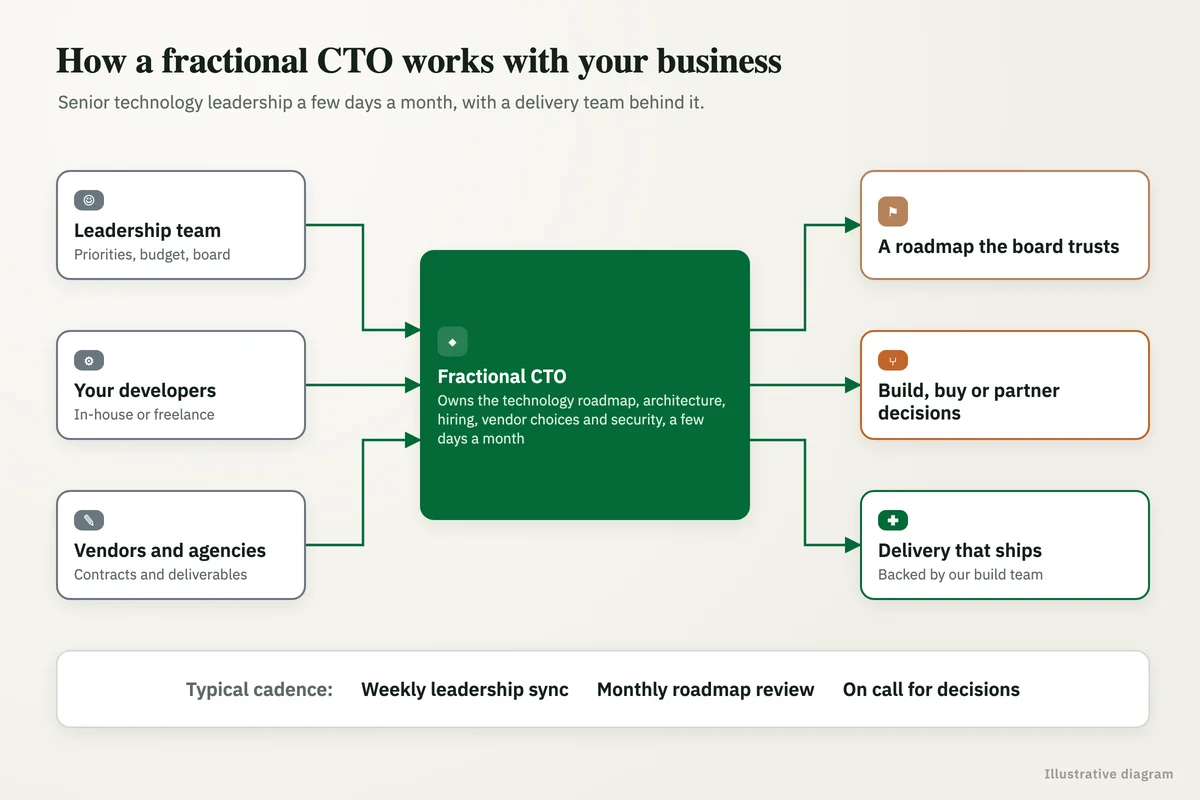
A fractional CTO is a senior technology executive who does the job of a Chief Technology Officer for your company part time, usually one to three days a week, on a retainer. They own the technology roadmap, architecture, team, vendors and security, at a fraction of a full-time CTO's cost.
The word fractional describes the time commitment, not the authority. A good fractional CTO sits in leadership meetings, makes and owns technology decisions, manages developers and agencies, reports to the CEO or board, and is accountable for outcomes. What you do not get is five days a week of their attention, because most fractional CTOs work with two to four companies at once.
You will see the same idea sold under several names. Part-time CTO and virtual CTO usually mean exactly the same thing. CTO as a service and outsourced CTO are the same model sold by a firm rather than an individual, often with a development team attached. An interim CTO is different: usually full time, for a fixed period, covering a gap until a permanent CTO starts. A fractional CIO does the equivalent job for internal IT and business systems rather than a product, and a fractional CAIO (Chief AI Officer) focuses only on AI strategy and adoption. The comparison table further down sets these side by side.
02
Signs you need a fractional CTO
03
When you do not need a fractional CTO
A fractional CTO is not the answer to every technology problem, and it is worth being honest about the cases where it is the wrong buy:
- You already have a strong technical co-founder or CTO. Then you may need a specialist (security, data, cloud) or more engineers, not a second leader.
- Technology is the product and the engineering team is large. Once you have a big team shipping daily, the role needs full-time presence. A fractional CTO can help you hire that person, but should not pretend to be them.
- The work is a single, well-defined build. If the scope is clear and someone on your side can own it, a good development partner with a fixed scope may be enough.
- You need someone to write code all week. A fractional CTO makes decisions and leads people. If what you are short of is hands on keyboards, hire developers.
- You only want a second opinion now and then. A technical advisor on a few hours a month is cheaper and more honest about the commitment.
The test we use: if the cost of the next wrong technology decision is larger than a few months of a fractional retainer, the role usually pays for itself. If it is not, start smaller.
04
What a fractional CTO does, by stage
Startups building the first product
At this stage the fractional CTO for startups is mostly preventing expensive mistakes. They turn the founder's idea into a scoped MVP, pick an architecture and stack the company can hire for and afford to run, and decide what to build, buy or leave out. Many early teams use an agency or freelancers, so the CTO writes the brief, reviews proposals and contracts, checks code quality and holds the vendor to the plan. They also make the first engineering hires and set up the basics: source control the company owns, environments, deployments, backups and access.
- MVP scope and build, buy or partner decisions
- Architecture and stack chosen for hiring and running cost
- Agency and freelancer selection and oversight
- First engineering hires and interviews
- Company-owned code, cloud accounts and credentials
- Technical story for the seed deck
Funded companies scaling a product and a team
After product-market fit the problems change: the system that worked for a hundred customers struggles at ten thousand, the team grows past the point where everyone talks to everyone, and enterprise customers send security questionnaires. The fractional CTO sets team structure and delivery process, decides where to pay down technical debt, puts in place security and reliability practice proportionate to the risk, and gets the company ready for technical due diligence before a fundraise or acquisition.
- Scaling plan for architecture, data and infrastructure
- Team structure, engineering managers and career levels
- Delivery cadence, code review, testing and release process
- Security baseline, access control and incident response
- Technical due diligence preparation for investors
- Cloud cost review and ownership
Established and non-tech businesses modernising
Many companies that hire a fractional CTO are not software companies at all. They are distributors, manufacturers, clinics, service firms and family businesses running on an ageing ERP, spreadsheets and a dozen disconnected tools. Here the job is modernisation: map the systems and processes, decide what to replace and what to integrate, automate repetitive work, get reporting onto a single source of truth, and adopt AI where it removes real work. Vendor consolidation is often the quickest win, because overlapping subscriptions and contracts accumulate quietly.
- Systems and process audit
- ERP, CRM and integration decisions
- Workflow automation and reporting
- Data foundations and AI adoption
- Vendor and licence consolidation
- IT governance, backups and security basics
05
Fractional CTO vs full-time, interim, virtual CTO, agency and advisor
The labels overlap, so compare the arrangements on what actually differs: how much time you get, how you pay, who owns the decisions and what situation each one suits.
| Option | Commitment | Cost model | Who owns technology decisions | Best for |
|---|---|---|---|---|
| Fractional CTO (also part-time CTO) | Ongoing, usually 1 to 3 days a week | Monthly retainer, sometimes a day rate | The fractional CTO, as part of your leadership team | Startups and SMBs that need senior technology leadership but not a full-time executive yet |
| Full-time CTO | Full time, permanent | Salary, bonus, benefits and usually equity | The CTO | Companies where technology is the product and the engineering team is large |
| Interim CTO | Often full time, for a fixed 3 to 12 month period | Day rate or monthly fee for the term | The interim CTO, until a permanent hire starts | Covering a sudden departure, a crisis, a merger or a turnaround |
| Virtual CTO / outsourced CTO / CTO as a service | Part time, often remote, frequently provided by a firm | Retainer, sometimes bundled with development work | Shared: a named senior person, backed by the provider | Companies that want leadership and delivery capacity from one partner |
| Development agency | Per project or per sprint | Fixed price or time and materials | You, or whoever writes the specification; the agency delivers it | A well-defined build with a capable owner on your side |
| Technical advisor | A few hours a month | Small retainer, hourly or equity | You; the advisor gives opinions, not decisions | Founders who need a sounding board and occasional reviews |
| Fractional CIO | Part time, ongoing | Monthly retainer | The fractional CIO, for internal systems | Businesses whose technology is internal IT, ERP and operations rather than a product |
| Fractional CAIO | Part time, ongoing | Monthly retainer | The CAIO, for AI strategy and governance | Companies whose main technology question is AI adoption; see our fractional Chief AI Officer service |
Two practical points sit behind the table. First, an agency has a commercial interest in recommending its own work, so it cannot be your independent check on that work. A fractional CTO can. Second, the boundary between a fractional CTO and CTO as a service is about who stands behind the person: an individual freelancer, or a firm with engineers who can build what the roadmap calls for. Both are legitimate; ask which one you are buying.
06
How much does a fractional CTO cost?
There is no official rate card, and published guides disagree, partly because they mix different seniority levels, countries and engagement sizes. Below are the figures from recent published sources, each with its date. Treat them as market signals, not quotes, and note that most come from firms that sell fractional services themselves.
Fractional CTOs are paid in one of five ways:
- Monthly retainer: a fixed fee for an agreed number of days or hours a month. The most common model for ongoing leadership.
- Day rate: common in the UK and for interim work, and for short assessments.
- Hourly: used for light advisory work and ad hoc reviews.
- Project fee: a fixed price for a defined piece of work, such as a technology audit or due diligence report.
- Equity: some early-stage startups pay part of the fee in equity. Agree vesting and what happens if the engagement ends.
Published fractional CTO rates (2026)
| Source and date | Market | Monthly retainer | Day rate | Hourly |
|---|---|---|---|---|
| Fractionus, June 2026 | US, established fractional CTOs with 10+ years' experience | $9,000 to $22,000; midpoint $13,000 to $16,000 for 2 to 3 days a week | $1,800 to $4,000 | $250 to $500 |
| Lemon.io, August 2026 | US and general | $3,000 to $15,000 standard range | Not stated | $150 to $500; $600 to $1,000+ for AI/ML and cybersecurity specialists |
| Dan Cumberland Labs, August 2026 | US, UK and India | $3,000 to $15,000 standard; $20,000 to $25,000 premium | Not stated | US $150 to $600; UK £100 to £400; India $50 to $150 |
| Red Eagle Tech, updated February 2026 | UK | £3,000 to £7,000 | £1,000 to £1,600; London £1,200 to £1,600, regional cities £800 to £1,100 | Not stated |
| Startupbricks, August 2026 | India | ₹40,000 to ₹80,000 (advisory, 4 to 8 hours a month); ₹1,20,000 to ₹2,50,000 (1 to 2 days a week); ₹3,00,000 to ₹5,00,000 (3 to 4 days a week) | ₹25,000 to ₹60,000 | Not stated |
The sources do not agree. US monthly figures run from $3,000 at the advisory end to $22,000 or more for two to three days a week of an experienced operator, and Fractionus's floor of $9,000 is three times Lemon.io's. The honest reading is that a few hours a month of advice and two or three days a week of real leadership are different products, and the price follows the days. Specialist work sits above these ranges: Lemon.io quotes $600 to $1,000 or more an hour for AI/ML and cybersecurity specialists.
07
Fractional CTO cost in India vs the US and UK
On these sources, an Indian fractional CTO costs far less in absolute terms: Dan Cumberland Labs (August 2026) puts India at $50 to $150 an hour against $150 to $600 in the US, and Startupbricks (August 2026) puts a 1 to 2 day a week engagement at ₹1,20,000 to ₹2,50,000 a month. The same Dan Cumberland Labs guide puts the UK at £100 to £400 an hour, and Red Eagle Tech (February 2026) gives UK day rates of £1,000 to £1,600, with London at the top of that range. Location matters less than fit, though: what you are paying for is judgement in your industry, at your stage, and the time zone your team works in.
08
Fractional CTO vs full-time CTO salary
The comparison most buyers make is with a full-time hire. Fractionus (June 2026) cites an average US CTO salary of $224,550 from Built In and estimates the true employer cost at $270,000 to $320,000 or more once benefits and payroll taxes are added. Startupbricks (August 2026) puts a senior full-time CTO in Bengaluru, Mumbai or Delhi at ₹35 lakh to ₹70 lakh a year plus equity. A full-time hire also takes months to recruit. A fractional engagement is cheaper per year, but you get fewer days; compare cost per day of senior attention and the cost of the decisions that will be made without one.
09
The first 90 days with a fractional CTO
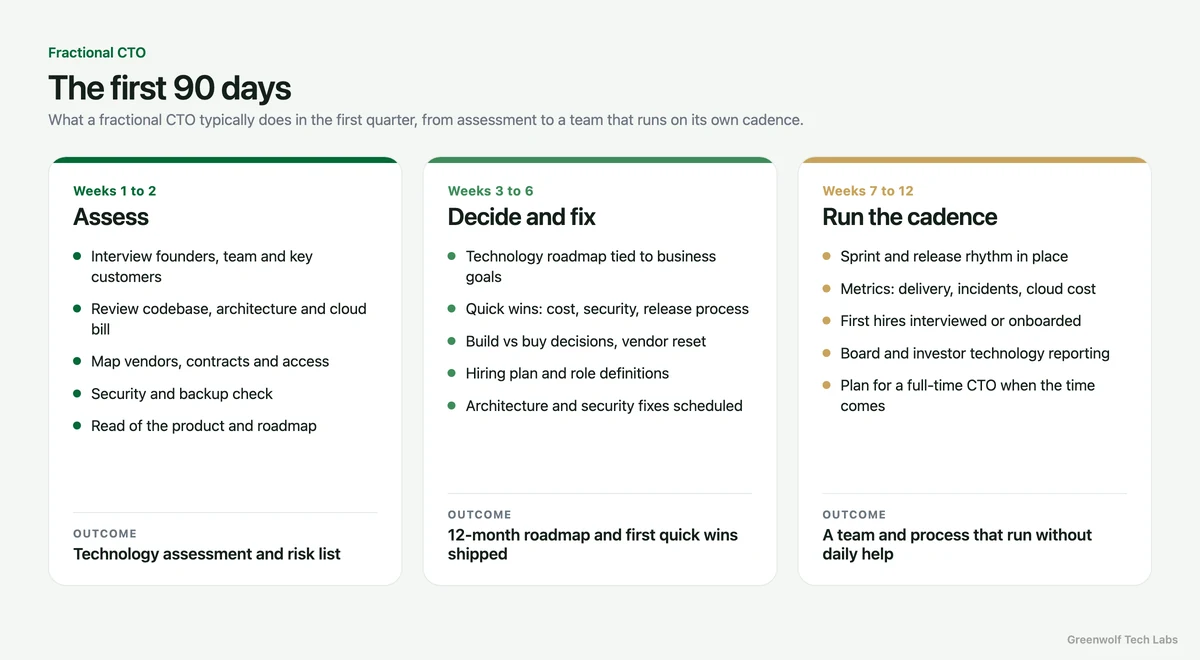
A fractional engagement is short on days, so the first three months need a clear shape. This is the pattern we follow and the one we would expect from any experienced fractional CTO.
Weeks 1 to 2: assessment. Listen before changing anything. Interviews with the CEO, leadership, engineers and key vendors; read access to code, cloud accounts, tickets, contracts and bills; a review of architecture, security posture, delivery history, team skills and technology spend. The output is a short written assessment: what is working, the top risks ranked by business impact, and the decisions that cannot wait. Often this is the first time the leadership team has seen the whole technology estate on one page.
Weeks 3 to 6: roadmap and quick wins. Turn the assessment into a technology roadmap for the next two to four quarters, tied to business goals, with owners, budget and trade-offs the leadership team signs off. In parallel, take the quick wins that build trust and reduce risk: secure admin access and move credentials the company does not own, fix backups, cut unused cloud resources and duplicate subscriptions, renegotiate or re-scope a vendor contract, unblock a stuck release. Quick wins should be visible and measurable, not cosmetic.
Weeks 7 to 12: team, process and delivery cadence. Put the operating rhythm in place so progress no longer depends on the fractional CTO being in the room. That means a team structure and clear ownership, a planning and release cadence the team can keep (for example two-week cycles with a demo), code review and testing standards, an incident process, hiring plans and job specs for the roles the roadmap needs, and a monthly report to the CEO or board on the agreed measures. By day 90 the company should have a roadmap, a working delivery process, a baseline for every KPI, and an honest view of whether the next step is more fractional time, less, or a full-time hire.
10
What a fractional CTO delivers
Technology roadmap
Quarterly priorities tied to business goals, with budget, owners and trade-offs the leadership team and board can follow.
- Two to four quarters ahead
- Build, buy or partner decisions
- Board-ready summary
Architecture and data
A documented target architecture for product, data and integrations, and a plan for the technical debt worth paying down.
- Architecture decision records
- Data and integration design
- Technical debt register
Team and hiring
A team structure, role definitions, interview process and the hires that the roadmap actually needs.
- Job specs and interviews
- Onboarding
- Full-time CTO succession plan
Vendors and contracts
Agencies, platforms and software chosen on merit, with scope, price and deliverables held to account.
- Vendor selection
- SOW and contract review
- Licence consolidation
Security and reliability
Access control, backups, monitoring and an incident process sized to your risk, plus answers for customer questionnaires.
- Access and identity
- Backup and recovery tests
- Due diligence pack
Automation and AI
Where automation, reporting and AI take real work off the team, prioritised by value and risk.
- Process automation
- Single source of truth
- AI use case shortlist
11
How to measure whether a fractional CTO is working
Agree the measures in the first month and baseline them, so the conversation at month six is about numbers rather than impressions. Which ones matter depends on your stage, but most engagements draw from this list:
| Measure | What it tells you |
|---|---|
| Delivery cadence | How often working software or changes reach users, and whether that rhythm is steady |
| Roadmap hit rate | Share of committed roadmap items delivered in the quarter they were planned for |
| Lead time for changes | Time from work starting to it being live |
| Incident rate and time to recover | How often production breaks, and how quickly it is fixed |
| Change failure rate | Share of releases that cause a problem needing a fix or rollback |
| Cloud and software cost | Infrastructure and licence spend, ideally per customer or per unit of revenue |
| Time to hire | Days from opening an engineering role to an accepted offer, and early attrition |
| Security posture | Open critical findings, access reviews completed, backup restores tested |
| Manual work removed | Hours a month of re-keying or reporting replaced by automation, for SMB engagements |
Expect the first quarter to set baselines and fix the riskiest items, and the trend lines to move in the second and third. If nothing measurable has changed after two quarters, that is a conversation to have.
12
How to choose and hire a fractional CTO
The market is crowded and the title is unregulated, so vet a fractional CTO the way you would a full-time executive, with extra attention to how they manage limited time.
Questions to ask
- Which companies at our stage and in our industry have you led technology for, and what changed while you were there? Can we speak to one of them?
- What would you do in the first 30 days here, and what would you need from us?
- How many clients do you work with at the moment, and how do you handle urgent issues on a day you are not scheduled with us?
- Tell us about a technology decision you got wrong and what you did about it.
- When would you recommend we stop using you and hire a full-time CTO? How would you help with that hire?
- Do you have a commercial relationship with any agency, platform or vendor you might recommend?
- Who owns the code, cloud accounts, documentation and credentials during and after the engagement?
- Who stands behind you if you are ill or unavailable, and can that team also build?
Red flags
- Recommends rewriting everything before understanding the business or the existing system.
- Proposes a stack or vendor in the first meeting, or earns undisclosed referral fees.
- Cannot describe a past engagement in terms of outcomes, only technologies.
- Will not agree measures or a review point, or wants a long lock-in with no exit clause.
- Wants admin access held in their own name rather than your company's accounts.
- Is spread across so many clients that response times are vague.
- Talks down to non-technical founders instead of explaining trade-offs in business terms.
Run a paid assessment of two to four weeks before committing to a long retainer. It is the cheapest way for both sides to find out whether the fit is real.
13
How Greenwolf's fractional CTO service works
Discovery call
A conversation about your stage, team, systems and the decisions on your desk. If a fractional CTO is not the right answer, we will say so.
Technology assessment
Two to three weeks reviewing systems, code, vendors, team, security and spend, ending with a written assessment and the risks ranked by business impact.
Roadmap and cadence
A roadmap for the next two to four quarters agreed with leadership, KPIs baselined, and a fixed rhythm: weekly sync, monthly roadmap review, quarterly board update.
Ongoing leadership
Your fractional CTO leads technology decisions, the team and vendors, at a time commitment you choose and can change as needs change.
Delivery and hand-over
Work built by our team or yours. When you are ready, we help you hire a full-time CTO and hand over cleanly.
14
Time commitment and the build team behind it
We offer the role at the level of time the work needs, and review it each quarter:
- Advisory: a few hours a month for roadmap reviews, vendor and architecture decisions, and a standing call.
- One day a week: the most common starting point for startups and SMBs with a small team or an external agency.
- Two to three days a week: for companies scaling a team, preparing for due diligence or running a major modernisation.
We scope the retainer after the discovery call rather than publishing a rate card, because the right number of days depends on your stage and the work in front of you.
What makes our model different from a solo fractional CTO is the team behind the role. When the roadmap calls for it, Greenwolf engineers can deliver custom software, AWS and Google Cloud infrastructure, data strategy and data platforms, AI consulting and implementation and wider digital transformation. You are never obliged to use us for delivery: the CTO can just as well brief and manage your own developers or another vendor, and we will tell you when that is the better choice.
15
Who leads our fractional CTO engagements
Greenwolf Tech Labs was founded by Harsh Khubchandani, who has more than ten years of experience in analytics, data and automation and previously worked at ZS Associates. He serves as Technical Advisor to PTC, Coste Sourcing and Greenwolf Advisors, which is the same kind of ongoing, part-time technology leadership this page describes.
Greenwolf works with clients in 18 countries. One example of the long-term ownership a fractional CTO relationship involves: for four years we have run a supplier intelligence platform for a France-based sourcing group that serves a US nuclear OEM, covering the architecture, data and day-to-day running of the system rather than a one-off build.
16
Fractional CTO questions
What is a fractional CTO?
How much does a fractional CTO cost?
Fractional CTO vs CTO as a service: what is the difference?
Do startups need a fractional CTO?
How many hours does a fractional CTO work?
Can a fractional CTO become full time?
What is the difference between a fractional CTO and an interim CTO?
Is a virtual CTO the same as a fractional CTO?
Talk to us about a fractional CTO
Tell us your stage, your team and the technology decisions on your desk. We will tell you whether a fractional CTO is the right fit, what the first 90 days would cover and what time commitment makes sense.
A reply from a consultant, usually within one working day.
Part of our Business Process Automation hub. Start with our business automation services.
Business Process Automation
More on business automation services
Fractional Chief AI Officer (CAIO): Role, Cost and First 90 Days
What a fractional Chief AI Officer does, CAIO salary and fees from cited 2026 sources, AI readiness, governance, the first 90 days and how to hire one.
Digital Transformation Consulting for Growing Companies
Digital transformation consulting for growing companies: processes, data, automation and AI changed in a practical order, with results measured at each step.
Custom Business Software and Application Development
Custom software development for business operations: internal tools, portals and workflow applications built around how your team works, and owned by you.
AWS and Google Cloud Consulting for Data, Automation and AI
AWS and Google Cloud consulting for data, automation and AI workloads: pipelines, warehouses, serverless automation and AI services, built and run cost-aware.
Hiring Checklist: 15 Things So You Do Not Hire the Wrong Person Again
A hiring checklist for small business owners: 15 simple steps, from the 90-day scorecard to reference calls, so your next hire is the right one.