Advanced manufacturing
Supplier Identification Services
Supplier discovery and capability scoring that cuts intake-to-award time.
Get a free proposal
Tell us what you need. A consultant replies within one working day.
01
Supplier identification and evaluation
Supplier identification is the work of finding every supplier that could make or deliver what you need, checking each one against your requirements (capability, certifications, capacity, lead time, location and risk), and turning a long list of hundreds into a defensible shortlist your sourcing team can send an RFQ to.
Most sourcing teams still do it by hand: Google searches, trade directories, certificate registries and old spreadsheets, re-filtered from scratch every time the same commodity comes up. It is slow, it misses suppliers outside the usual circle, and the knowledge leaves with the person who did the search.
Greenwolf builds supplier intelligence systems that do the searching, screening and record-keeping continuously. We have run one for four years for a France-based sourcing group serving a US nuclear OEM, covering automated supplier identification, supplier records with capability and qualification attributes across the procurement dataset, categorisation of procurement data, and comparison and shortlisting. For regulated, code-qualified supply chains, see our dedicated nuclear supplier identification service.
02
Why supplier identification is harder than it looks
The usual suppliers
Teams return to the suppliers they already know, so capable alternatives in other regions are never considered.
Records that go stale
Certificates expire, owners change and capacity moves, but the spreadsheet still says what it said two years ago.
Repeated searches
The same commodity is researched from scratch every time it comes up, because the last search was never saved in a usable form.
Unverified claims
Websites list certifications that have lapsed or cover a different site or scope than the one you are buying from.
Single-source exposure
Nobody can say quickly which commodities have only one qualified source until a supplier fails.
No audit trail
When a shortlist is challenged, there is no record of who was considered, why they were dropped and on what evidence.
03
How we identify and qualify suppliers
Define the requirement
Commodity, specification, volumes, certifications required, regions allowed, lead time and the criteria that decide a shortlist, agreed with the category owner.
Search wide
Automated scouting across certificate registries, industry associations, trade directories, import and export records and the open web, plus the suppliers already in your records.
Screen against hard criteria
Capability, certifications and scope, location and export rules applied as rules, so every exclusion has a reason attached.
Enrich the supplier record
Certificates and their expiry, capacity and equipment, past supply history, ownership, financial signals and contacts, held in one structured record per supplier.
Score and shortlist
A weighted score on your criteria, reviewed by a person, producing a shortlist and a comparison pack the sourcing team can act on.
Keep it current
Expiry and change alerts, re-screening on a schedule, and the search saved so the next request for the same commodity starts from today's answer.
04
What a supplier intelligence view shows
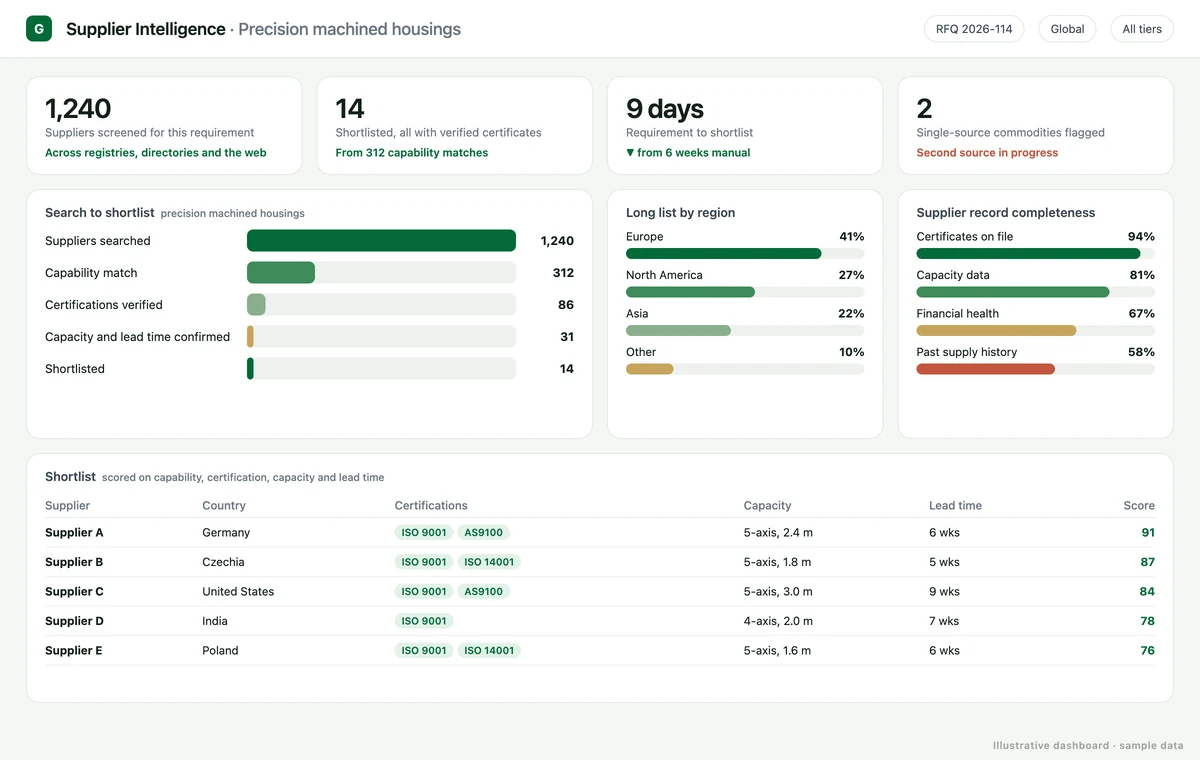
The output is not a one-off spreadsheet. It is a living view of the search: how many suppliers were screened, how many passed each gate and why, how complete each supplier record is, and a scored shortlist with the evidence behind every score. The example below is illustrative, with sample data.
Decisions it drives: who receives the RFQ, where a second source is needed, which records need verifying before award, and how long the next search for the same commodity will take.
05
The supplier record we build
Every supplier we find gets one structured record, so the next search starts from it rather than from Google.
| Attribute | What we hold | Why it matters |
|---|---|---|
| Identity | Legal entity, sites, ownership, parent company | Certificates and capacity belong to a site, not a brand |
| Capability | Processes, materials, equipment, size and tolerance range | The first filter for any requirement |
| Certifications | Standard, scope, issuing body, site, expiry date | Lapsed or out-of-scope certificates are the most common false positive |
| Capacity and lead time | Typical lead times, capacity signals, shifts, recent expansions | Decides whether a capable supplier can actually deliver |
| Supply history | Past RFQs, awards, quality issues, delivery performance | Your own experience, kept instead of forgotten |
| Risk signals | Location, export controls, financial health, single-source flags | Surfaces exposure before it becomes a disruption |
| Categorisation | Your category taxonomy and commodity codes | Makes the dataset searchable by the way your team buys |
We can hold this in your own systems (a sourcing tool, ERP vendor master, data warehouse or a structured sheet) and keep it aligned with your supplier master data.
06
Supplier evaluation criteria and scorecard
Supplier evaluation turns the long list into a ranking you can defend. We agree the criteria and weights with the category owner before scoring anyone, so the shortlist reflects your priorities rather than whoever replied first.
| Criterion | What is checked | Typical weight |
|---|---|---|
| Technical capability | Processes, materials, size and tolerance range against the specification | 25 to 35 percent |
| Quality and certifications | Certificates in scope and in date, quality history, audit outcomes | 20 to 30 percent |
| Capacity and lead time | Ability to meet volumes and dates, current load | 15 to 20 percent |
| Commercial | Indicative pricing, payment terms, total landed cost | 10 to 20 percent |
| Risk | Financial health, location and logistics, export controls, single-source exposure | 10 to 15 percent |
| Fit | Communication, responsiveness, willingness to collaborate on development | 5 to 10 percent |
The weights above are a starting point, not a rule: in regulated supply chains, quality and certification often act as a pass or fail gate before any weighting applies. The supplier qualification process (audits, samples, first article inspection and document review) then follows for the shortlisted suppliers only.
07
Results from four years of supplier intelligence work
For a sourcing and supplier quality firm that searched for suppliers manually on Google and filtered them by hand-applied rules, we replaced the process with an automated scouting and screening pipeline. The case study reports 85 percent less time and 91 percent lower cost for the move from manual to automated scouting (read the case study).
The system has since run for four years for a France-based sourcing group serving a US nuclear OEM, holding supplier records with capability and qualification attributes across the procurement dataset and producing comparisons and shortlists on request.
08
Who we work with
Sourcing houses
Firms that find and qualify suppliers for their clients and need faster, defensible shortlists.
Regulated industries
Nuclear, aerospace, defence, marine and medical supply chains where qualification decides who can be used.
Manufacturers
Procurement teams second-sourcing components, localising supply or recovering from a supplier failure.
Procurement advisory
Consultancies that own the client relationship and want a delivery bench for supplier research.
09
How we handle your data
10
Related services
Supplier identification usually sits alongside supplier evaluation and shortlisting, supplier categorisation, supply chain automation and enterprise master data management. For the platforms on the market, see our guide to AI supply chain software.
11
Supplier identification questions
What is supplier identification?
How do you find new suppliers for a component?
What are the criteria for supplier evaluation?
What is the difference between supplier identification and supplier qualification?
How long does a supplier search take?
Can you find suppliers in specific countries or regions?
Do you work with regulated or nuclear supply chains?
Tell us which commodity you are sourcing
Describe the requirement and how you search for suppliers today. We will come back with how a supplier intelligence system would handle it.
A reply from a consultant, usually within one working day.
Part of our Supply Chain and Procurement hub. Start with our supply chain automation.
Supply Chain and Procurement
More on supply chain automation
Smart Supplier Identification and Selection: Enhancing Your Business with Automation
We help nuclear, aerospace, marine & defense companies discover verified, capable suppliers, fast. Sourcing for complex systems isn’t easy. You need suppliers who are technically competent,...
Nuclear Supplier Identification and Qualification Support
Nuclear supply chain supplier identification: find NQA-1, 10 CFR 50 Appendix B and ASME N stamp suppliers, with qualification records kept current.
Supplier Shortlisting Services
Challenges of Suppliers Shortlisting How Supplier Shortlisting Services can Benefit Businesses Types of Supplier Shortlisting Strategic Fit Identifying suppliers aligned with your business goals...
Supplier Categorization Service
Challenges of Supplier Categorization How Supplier Categorization Services can Benefit Businesses Types of Supplier Categorization Strategic Relevance Categorize suppliers based on their strategic...
Critical Path Method Software: How CPM Scheduling Works and What to Use
What critical path method software does, a worked CPM example with forward pass, backward pass and float, schedule quality checks and how to choose a CPM tool.